
Alabaster Ring Chandeliers: How to Choose Size, Color, and Light Settings
|Lightyra Editorial Team

Choose an alabaster ring chandelier in three steps: find a diameter that works with the furniture below it, choose the stone and strap color that belongs in your room, and plan how you want the light to feel through the day. A fixture this visible earns its place when those three decisions agree with each other.
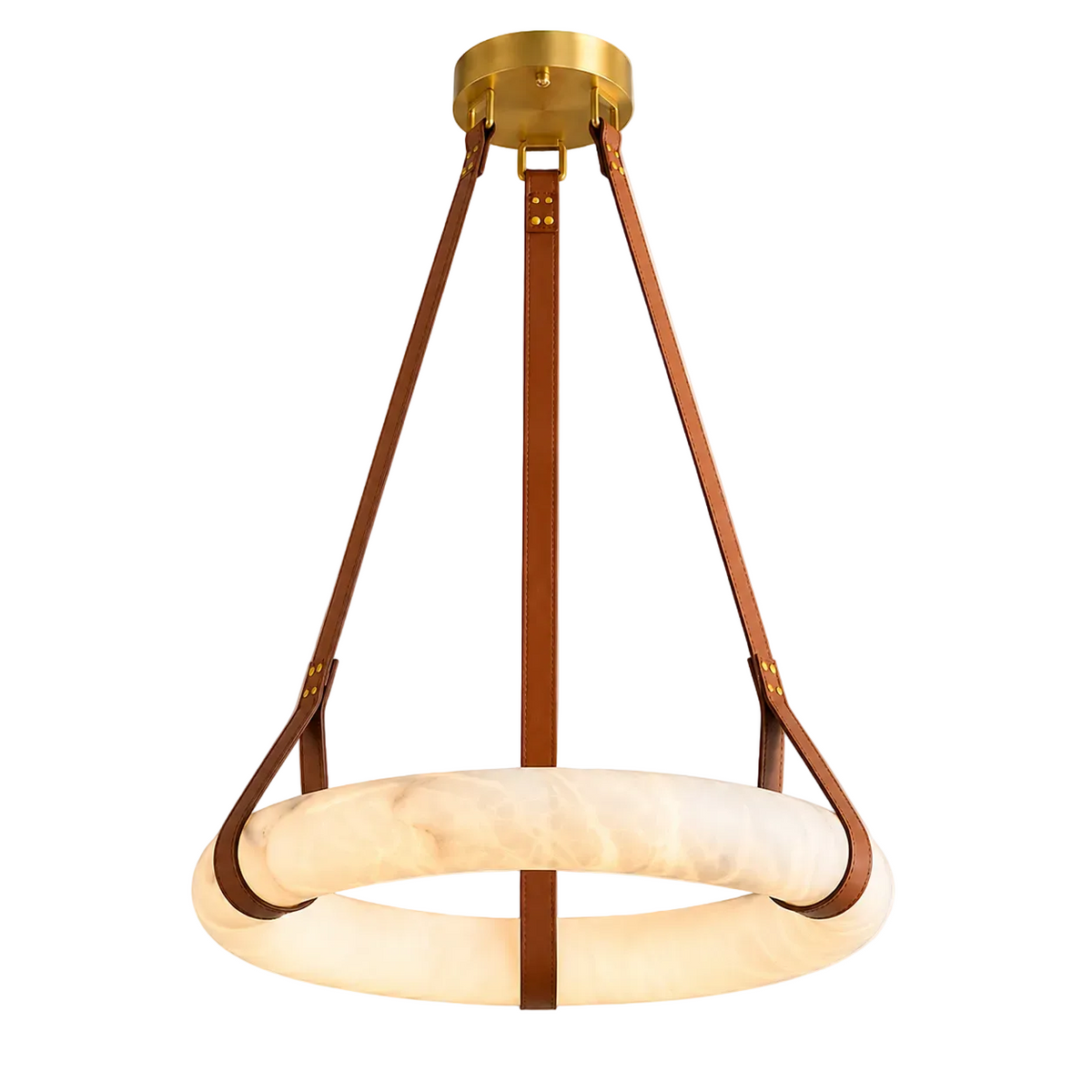
Our Oslo Natural Alabaster Ring Chandelier is a useful example to work through, because it puts a pale stone ring on leather suspension straps with metal details. The circle gives the room a clear center; the open middle keeps it from feeling heavy. Here is how to move from liking the photograph to choosing a version for your own space.
The short version
- Diameter lands somewhere between one-half and two-thirds of the table’s width — then you test it on the floor with tape before you commit.
- Strap color should repeat something already in the room: window frames, chair legs, cabinet hardware, wood or leather tones.
- Light settings are three separate dials: color appearance, color rendering, and brightness. Solve them in that order.
Decide what the ring should bring to the room
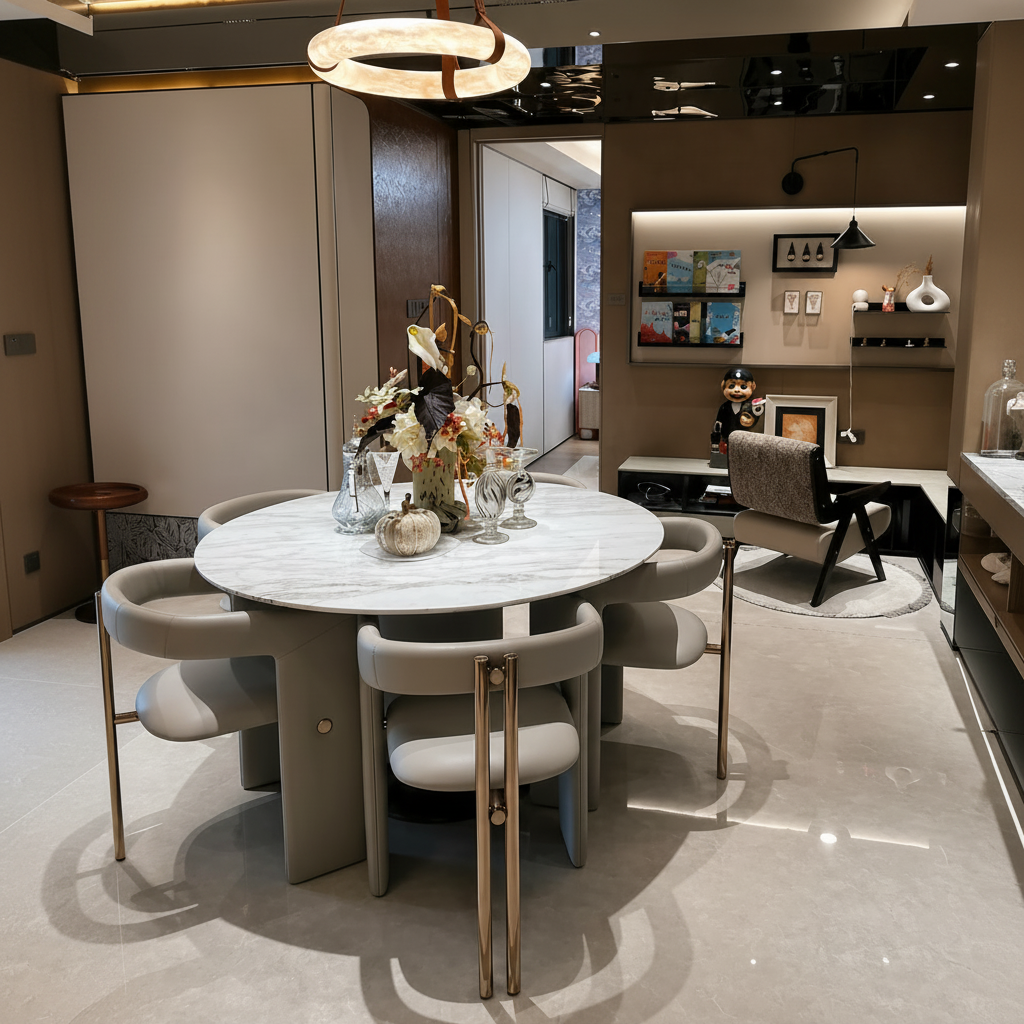
Start with the view you actually care about: the table as you walk in, the seating arrangement from your usual chair, or the transition between two adjoining spaces. A circular chandelier can echo a curve that already exists — a round tabletop, an arched doorway — or it can introduce a curve into a room built entirely from straight edges.
Over a round table, a ring creates a shared center for everyone seated. Over a rectangular table, it emphasizes the middle rather than following the table’s full length. If your main goal is one long visual line across an extended table, that is worth comparing against other chandeliers in the collection before you settle on a circle. The decision is about composition as much as measurement.
Look above the ring too. Oslo’s leather straps are part of the silhouette: they draw the eye upward from the stone to the ceiling, and they are visible from the doorway. Choose this design when you want the suspension to be part of the composition rather than a fixture that sits tight to the ceiling. That distinction is worth settling before you start comparing diameters, because it changes which sizes will look right.
Choose a diameter with a real comparison, not a room photograph
Oslo is available in four diameters:
| Size | Diameter | Total height |
|---|---|---|
| Small | 23.6 in / 60 cm | 59.1 in / 150 cm |
| Medium | 31.5 in / 80 cm | 59.1 in / 150 cm |
| Large | 39.4 in / 100 cm | 59.1 in / 150 cm |
| Extra large | 47.2 in / 120 cm | 59.1 in / 150 cm |
Measure the tabletop, or the defined area beneath the fixture if it is not going over a table. For a dining table, our chandelier size and placement guide uses roughly one-half to two-thirds of the table’s width as an initial visual proportion. That is a design starting point — not an installation clearance, and not a guarantee of fit in a room with a low ceiling or a tight walkway.
A worked example: a 60-inch round table
One-half to two-thirds of a 60-inch tabletop gives a starting range of 30 to 40 inches. Two Oslo sizes sit inside it: 31.5 inches and 39.4 inches.
Centering the 31.5-inch ring leaves about 14.3 inches between its outer edge and the table edge on each side. The 39.4-inch ring leaves about 10.3 inches. Those figures describe the plan-view proportion only; they say nothing about a safe hanging height.
Both are defensible. Shortlist the smaller one if you want more of the tabletop’s outline to stay visible around the ring, and the larger one if you want the chandelier to hold more of the table’s visual footprint. The rest of the room can break the tie: a large artwork, a busy table setting or a strong rug may already carry plenty of visual emphasis.
Test your two finalists at full scale
Cut two paper outlines, or mark both diameters on the floor with removable tape that suits the surface. Compare them against the table, then look from the doorway and from a seat. It is a crude test, but it makes a three-inch difference between two options feel real. It does not simulate the installed fixture or its light.
On a rectangular table, measure the short side as well as the length. A long table can still be narrow, and choosing by length alone leads you to a ring that overpowers the width. Keep the vertical decision separate: Oslo’s total height is 59.1 inches / 150 cm, so resolve the installed drop before ordering rather than after the box arrives.
Match the stone, leather and strap color to the room
Oslo combines natural alabaster, stainless steel and genuine leather. In the product imagery the pale, veined ring is the broad horizontal element and the darker straps add clear vertical lines — that contrast is where most of the design’s character comes from. If you want to see how the material behaves on other silhouettes, the alabaster lighting collection shows the same stone in different forms.
If your room is dominated by straight lines and smooth, uniform surfaces, the ring and its visible stone veining supply the variation the room is missing. If you already have strongly patterned stone, coarse wood grain or bold textiles, give the chandelier a quieter backdrop so the two patterns do not compete. Neither approach requires matching every material in the room.
Black and Brown are two ways to tie the composition back to the furniture. Black straps can repeat dark window frames, chair legs or cabinet hardware. Brown straps can connect to leather, walnut or oak tones. Treat them as palette options rather than verdicts on whether a room is “modern” or “traditional”.
Take a pale wood table with black chairs, for instance. Black carries the chairs’ dark lines upward and makes the fixture feel like part of the seating group. Brown instead brings a second warm element above the table, which usually reads softer and more collected. Put both product images next to a photograph of your room and ask which existing detail you want repeated — that question is easier to answer than “which one looks better”, and it is the one that predicts whether you still like the fixture in five years.

Choose the light setting for the way you use the space
Color appearance, brightness and color rendering answer three different questions. Keeping them apart is what makes the specifications useful instead of confusing.
Warm, neutral and cool white: start with the occasion
For an evening meal or a quiet conversation, warm white is the natural setting — it makes faces and food look the way people expect dinner to look. If the same table doubles as a desk for paperwork, projects or homework, compare neutral white against the room’s other lights and against the appearance you want on the work surface.
Cool white is a cooler-looking alternative for rooms where that appearance suits the palette. It is not automatically brighter, and it is not automatically better for close work. Keep neighbouring fixtures visually compatible, especially in an open-plan room where several lights are in view at once.
Oslo offers all three settings, so the choice is about appearance rather than about buying three different fixtures. Once the appearance is settled, use dimming to set the level. Changing color setting and lowering brightness are separate decisions: warm white at full output feels quite different from the same setting dimmed for the evening.
Color rendering: think about the objects under the light
Color rendering describes how a light source makes colored objects appear compared with a reference source. Oslo is rated CRI Ra ≥ 90, which matters if you care how food, upholstery, tableware or nearby artwork read under the fixture — not just how the light itself looks.
Choosing between warm and neutral addresses atmosphere. Color rendering addresses a different concern: whether the colors in the room stay believable. Neither tells you how much light the fixture produces.
Brightness: plan the ring’s role in the whole room
Oslo uses a built-in 20W LED. Watts describe electrical power, not light output; lumens describe light output, and a wider ring is a larger object rather than a brighter one — the same 20W source sits inside every diameter.
Picture the chandelier alongside the other lighting you expect to use. Over a table it may be the visual centerpiece while lamps or recessed lights serve the surrounding area. If the room also handles detailed work, assess the light reaching that surface separately from the chandelier’s decorative job.
For a coordinated control setup, settle three things with our team before ordering: dimmer compatibility, how the three color settings are selected, and any specific output or Kelvin target you are trying to hit. One conversation resolves the technical details that are awkward to fix after installation — and if you are new to buying light you cannot see first, our guide to shopping for lighting online covers the rest of the checklist.
Bring the choices together before ordering
A shortlist worth acting on has three decisions behind it: a diameter tested against the furniture, a strap color connected to the room’s palette, and a lighting role that matches how you spend time there.
For the 60-inch round table above, that might mean comparing the 31.5- and 39.4-inch rings, choosing the strap color that echoes the chairs or the wood, and planning a warm evening setting alongside the room’s other lights. Your measurements may point somewhere else — the method stays the same.
You can compare all four diameters and both strap colors on the product page, including the dimension drawings and the finish photographs. If you would rather not decide alone, send Lightyra your table dimensions, ceiling height and a room photograph with your shortlist — the team will tell you which size they would put there and what to check on site. Dining rooms are the most common setting for this piece; if the rest of the room still needs finishing, the dining room lighting collection covers pendants, sconces and lamps that sit comfortably beside it.
Installation note: Oslo is an indoor, hardwired pendant on a 110–240V supply, covered by a one-year warranty. Have a qualified electrician confirm the installed drop, ceiling support and electrical compatibility before the fixture goes up — our ceiling support guide covers the electrical box, weight and preparation questions worth raising with them.
FAQ
What size chandelier for a 60-inch round table?
Between roughly 30 and 40 inches, which puts the 31.5-inch and 39.4-inch Oslo rings in range. The smaller size keeps more of the tabletop outline visible; the larger one makes the fixture the dominant element. Check the drop against your ceiling height before choosing between them.
Can the Oslo ring chandelier be dimmed?
The fixture is dimmable, but dimming depends on the switch and driver pairing in your installation. Confirm the dimmer model with Lightyra before ordering so the electrician fits a compatible one — replacing a dimmer afterwards costs more than specifying it correctly.
Do I need all three color settings?
Not necessarily. Most dining rooms settle on warm white for the evening and leave it there. The neutral and cool settings matter more in rooms that double as workspaces, or in open-plan spaces where the chandelier is seen next to cooler ceiling lights.
Will natural alabaster look exactly like the photographs?
No — every ring is cut from natural stone, so veining, translucency and the exact warmth of the pale surface vary from piece to piece. Photographs show the character of the material rather than one guaranteed pattern. If a specific look matters to you, raise it with the team before ordering so the expectation is on record.
Is the ring chandelier suitable for a low ceiling?
Oslo’s total height is 59.1 inches / 150 cm as supplied, strap length included. In a room under about 8 feet, confirm the achievable drop with the team and with your electrician before ordering — and keep in mind that pulling the ring up tight to the ceiling removes the strap, which is a large part of the design.
0 comments